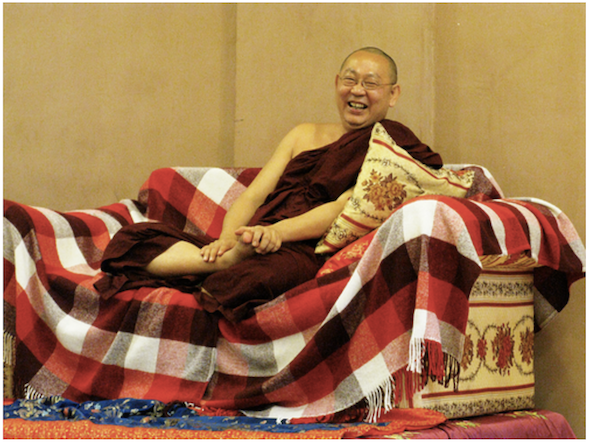
SAYADAW U TEJANIYA
THE DAILY TEJANIYA IN 2026
This year, the Daily Tejaniya is progressing through Sayadaw U Tejaniya’s guide to daily life meditation, Relax and Be Aware: Mindfulness Meditations for Clarity, Confidence, and Wisdom. This page contains the daily email messages drawn from the book in the order they are published.
A weekly online practice group, Monday Friends, is working through Relax and Be Aware through 2026, using The Daily Tejaniya messages as a guide. The group is free and open to anyone to drop in any time.
To receive a weekly reminder of the meetings, and the short readings being studied and practiced each week, click here.
THE PATH OF WISDOM
“WE ALWAYS START WITH AWARENESS” We always start with awareness. It is that
quality that grounds us and allows all the whole-
some mind states to arise, especially the quality of
wisdom. When awareness and wisdom are working
together like this, we gain the confidence and the mo-
tivation to to keep exploring and moving into the un-
charted regions of our minds, where wrong view
starts the cycle of suffering at a subtle level.
“WISDOM IS WHAT THIS PRACTICE IS ABOUT” Wisdom is what this practice is about. It
is the quality of mind that understands the
true nature of reality. It becomes the compass
that points the way as we try to understand
and remove the mind’s three unwholesome
roots of craving, aversion, and delusion.
“A MEDITATOR’S JOB IS TO REMEMBER TO BE AWARE" A meditator’s job is to remember to be aware. Whether you are standing, lying
down, or walking, if you remember that
you are aware, then you are meditating,
and you are cultivating this wholesome quality of mind.
“WHAT THE MIND IS AWARE OF ISN’T REALLY IMPORTANT” What the mind is aware of—the objects
of awareness such as sensations, thoughts,
perceptions, and emotions—isn't really im-
portant. What's important is the quality of
the observing mind that is always working
in the background to be aware. The more
we remember to be aware, the more we
nourish the wisdom that dissolves
stress and suffering.
“FORGET THE IDEA THAT MEDITATION ONLY HAPPENS ON A CUSHION” Forget the idea that meditation happens
only on a cushion or in the meditation hall.
Meditation is so important that we need to do
it all the time, whenever we can remember. We
should meditate from the moment we wake
up until the moment we fall asleep.
“RELY ON WISDOM. IT WILL STAND BY YOU.” As individuals we don't really know how to
deal with the three unskillful root qualities of
mind—craving, aversion, and delusion. That's
why the right thing to do in practice is to grow
the wisdom quality of mind, which knows how
to remove these unwholesome roots. Aware-
ness grows wisdom. So, rely on wisdom.
It will stand by you.
“THERE IS A NATURAL PROGRESSION IN THE GROWTH OF AWARENESS” There is a natural progression in the growth of
awareness. You might start off with noticing just
one object, say the breath.
After a while, you will become aware of several
objects in the body, say of sensations in the belly,
hands, and chest. Then you may notice your feelings
while being aware of all these objects in the body.
Later on, you'll become able to be aware not only
of objects and feelings, but also of awareness, plus
the attitude that is behind this awareness.
Once you're able to see this whole picture, you will
begin to understand how all these objects interact
with one another to create either more stress or
more ease in the mind.
This is understanding. This is wisdom.
RIGHT ATTITUDE IS LEARNING FROM YOUR EXPERIENCE JUST AS IT IS Right attitude is accepting, observing, and learning from you experience just as it is.
This is the right frame of mind to meditate. It is a mind that is free of compulsive liking and disliking and therefor is able to see things clearly as they are.
Right attitude allows you to accept, acknow- ledge, and observe whatever is happening— whether pleasant or unpleasant—in a relaxed and alert way.
“WHATEVER YOU ARE EXPERIENCING IS THE RIGHT EXPERIENCE” Whatever you are experiencing in this
moment is the right experience. There is
no need to be happy or unhappy with what
is happening, and there is no need to like or
dislike the experience. This is the right
attitude for meditation.
“WE NEED TO BE CHECKING OUR ATTITUDE ALL THE TIME” We need to be checking our atti-
tude* continuously. Are we behaving
mostly based on our likes, dislikes, or
ignorance of what is really going on?
Liking something means you desire it;
disliking something means you have an
aversion to it. Desire and aversion both
arise out of delusion, which is not
seeing the present reality.
* Sayadaw defines right attitude as accepting, ob-
serving, and learning from your experience just as it is.
Desire, aversion, and delusion are referred to in Bud-
dhism as the three unwholesome roots of the mind.
“DON’T TRY TO CREATE A POSITIVE MIND STATE” Don't try to create anything, such as a
positive mind state, because trying to create
something is greed. Do not reject what is hap-
pening, such as a negative mind state, because
rejecting what is happening is aversion. Not
knowing whether something is happening
or is not happening is delusion.
“BE NATURAL AND SIMPLE. LEARN FROM EVERY EXPERIENCE.” In meditation we learn how the
mind and body relate. Just be nat-
ural and simple. Learn from every
experience. There is no need to slow
down unnaturally. You simply
want to see things as they are.
“DO NOT TRY TO HAVE THE RIGHT ATTITUDE” We all have wrong attitudes;
we cannot help having them. Like
everything else, they are just nature.
So do not try to have the right atti-
tude. Instead, try to recognize, ac-
cept, observe, and learn about
your wrong attitudes.
THERE IS A NATURAL PROGRESSION IN THE GROWTH OF AWARENESS There is a natural progression in the growth of
awareness. You might start off with noticing just
one object, say the breath.
After a while, you will become aware of several
objects in the body, say of sensations in the belly,
hands, and chest. Then you may notice your feelings while being aware of all these objects in the body.
Later on, you'll become able to be aware not only
of objects and feelings, but also of awareness, plus
the attitude that is behind this awareness.
Once you're able to see this whole picture, you will
begin to understand how all these objects interact
with one another to create either more stress or
more ease in the mind.
This is understanding. This is wisdom.
ONE MEDITATOR’S CHALLENGE WITH RIGHT ATTITUDE A meditator once came to practice at our center and
became quite frustrated because she didn't understand
what I meant when I asked, "What is your attitude?"
It took her three weeks of intensive investigation before
she understood "attitude" as it related to her practice.
She had been practicing watching the breath meditation,
and also trying to observe her thoughts, but she just
couldn't figure out attitude. Where was it? What was it?
Then it came to her quite suddenly. She explained: "It
was the lens through which I was perceiving. Once the
object was colored by this lens, it was changed to rein-
force my own personality structure. Essentially, objects
became tools for building the self."
This was a very powerful insight for her. It helped her
understand why she was so irritated by life. She was
wearing the irritation-colored lens.
This pattern had been reinforced over a lifetime of atti-
tudes arising to create and protect the "self," because
better skills like compassion or loving-kindness had not
been there to ease the challenges of her life
After she left our center, she was able to keep the insight
alive in her daily life, where it has helped her face the
challenges of a committed relationship, and the lack of
"exit" that comes with motherhood.
THE DEFILEMENTS PREVENT US FROM LIVING LIFE FULLY The three unskillful root qualities of craving, aversion,
and delusion prevent you from living your life fully. They
prevent you from finding true peace and freedom. Look
out for them.
As you stop attaching to or identifying with them, their
strength will slowly diminish.
When you wait and watch with awareness and intelligence,
you will see that experiences are just happening according
to their own nature. Let whatever happens happen.
There is no need to be happy or unhappy with what is hap-
pening, and there's no need to like or dislike any experience.
Be happy that there is knowing and awareness, as this in
itself is already wholesome.
IT IS NOT “I” THAT MEDITATES. IT IS THE MIND. Meditation is the work of the mind.
It is not "I" that meditates. It is the mind.
We help the mind do its work by paying atten-
tion to our experiences with right attitude, in
order to learn about the workings of the whole-
some and unwholesome roots of the mind.
RIGHT EFFORT IS PERSEVERING IN A RELAXED WAY Right effort isn't about intensely focusing attention
on something.
It is persevering in a relaxed way.
The meditating mind is relaxed.
Meditation shouldn't make the mind or the body
tired. If you are practicing correctly with right effort,
it will bring peace and joy.
But if you are putting in wrong effort, you will feel
tired and unhappy when you practice.
Whenever we strive to experience something pleas-
ant, or to avoid something unpleasant, we get tired.
The meditating mind, the mind that is doing the work
of meditation, must be a wholesome mind.
In a wholesome mind the qualities of confidence, en-
ergy, mindfulness, stability of mind, and wisdom are
at work, replacing craving, aversion, and delusion,
at least to some degree.
However, sometimes when we make an effort, we do
so unskillfully. At these times, when one or more of
the three unwholesome roots come into the mind
and stays unnoticed, our effort becomes wrong effort.
We need to soften our focus and relax.
There should be continuous effort but not exertion.
YOU DON’T NEED MUCH EFFORT TO BE MINDFUL We don't need to use too much effort or too
much energy to be mindful.
Every day we wake up, we open our eyes,
and seeing begins to happen. But how often
do we consciously notice this?
When we do, that is awareness. It is the realization
of our present moment experience. That's all.
USE THE SIX SENSE DOORS TO DEVELOP AWARENESS It's easy to be aware, because all we can truly
be aware of is our six senses—seeing, hearing,
tasting, touching, smelling, or thinking.
So in any moment, all we need to do to be
aware is to ask questions like "What is being
known now?" "What is being seen now?"
"What sounds are being heard?" "What
thoughts are being known?"
If we remember to recognize that "knowing
is happening" at any one of the six sense doors
at any given moment, then awareness is present.
If we remember continuously in this way, we
will be continuously developing awareness,
stability of mind, and wisdom.
THIS IS ALL THE ENERGY YOU NEED Right now, are you aware of your posture?
Are you aware of you hands?
Can you feel your feet?
Notice how little energy or effort you need to
know any of this!
This is all the energy you need to remain aware.
But remember, you need to do this all day long.
CONSERVE YOUR ENERGY OR YOU’LL RUN OUT OF STEAM We don't need to use too much effort to be aware.
Big bursts of effort make us run out of steam.
Conserve energy so you keep going all day.
It is very important to keep trying to maintain the
intention to remain aware all the time, whether
awareness is actually continuous or not.
This points to the essential quality of right effort:
persistence.
It's not a forceful effort, but rather an inner deter-
mination to sustain the tiny bit of energy you need
in each moment to know you are aware, and to
keep that going.
Keep up the intention and commitment, and don't
give up. Persevere throughout the day. It takes
some practice, because in order for awareness
to become constant, it needs to become a habit.
For something to become a habit, we have to
keep after it all the time.
AWARENESS IS ALWAYS ON AND OFF, ON AND OFF In the beginning, awareness is always on and
off, on and off, and we just persevere.
We remember, we keep going.
We forget, we remember, we keep going.
IT’S POSSIBLE TO MEDITATE IN EVERY SITUATION It's very possible to consciously observe and investigate
the mind and body in every situation.
We should use all moments of life in this way as much as
possible. In fact, all the time if possible.
Meditation can happen whenever we are alone and not
occupied, such as when we are in the bathroom.
After some practice, we can also meditate when we are
talking and interacting with other people.
If we are determined to do this over and over again, even
in the course of one day, we will get many, many minutes
of meditation.
If you're able to set aside time to do a sitting practice
each day, you are welcome to do that as well.
But don't let go of the other bits of meditation.
Every minute that we do this, we accumulate the
power of mindfulness.
WHILE LYING DOWN, BE SURE TO PRACTICE WITH RIGHT EFFORT When we meditate while lying down, we must
exercise the mind more, otherwise we'll fall asleep.
While lying down, all the effort should be geared
toward being aware.
If we become too relaxed, we'll doze off.
It certainly is okay to practice lying down—just be
careful not to fall asleep!
Check in frequently to notice the energy you are using,
and make sure you are practicing with right effort.
CRAVING, AVERSION AND DELUSION TORTURE AND TORMENT US Automatic liking and disliking of objects and awareness
tends to compel most of the actions in our daily life.
This is the habit of our minds.
So it's not a surprise that this habit shows up in medita-
tion and tries to run the show there too.
We need to thoroughly understand how much the three
unskillful root qualities of mind—craving, aversion, and
delusion— are torturing and tormenting us.
We haven't learned this lesson fully yet.
We don't learn our lesson the first time, the second time,
the third time.
WHEN THE DEFILEMENTS ARISE, WE SERVE THEM TEA AND BISCUITS When craving, aversion, and delusion arise, we
usually welcome them into our homes as guests
and serve them tea and biscuits.
Isn't this true?
Our list of likes and dislikes, for example, form
a large part of our personalities, which we are
attached to.
We'll only turn for help from wholesome quali-
ties when we realize the defilements are running
our lives, and we can no longer stand them.
WE’RE NOT TRYING TO GET RIDE OF CRAVING, AVERSION, AND DELUSION We're not trying to get rid of craving, aversion,
and delusion, but instead are working to notice
them and to learn about them.
We want to know the true nature of both the skill-
ful and the unskillful qualities of mind.
Check the mind frequently to see if the skillful or
unskillful qualities are leading your practice, and
and to learn their effect on the mind.
"FOCUSING HARD MAKES US TIRED. WE NEED TO SOFTEN OUR FOCUS" Whenever craving, aversion, or delusion is present
and motivating the practice, we begin to overexert.
When we want experience to be a certain way, that's
craving, and we start to strive and put in too much
effort.
When we are dissatisfied with something, that's aver-
sion, and we try to avoid it or make it go away.
Focusing hard makes us tired.
It's happening because of craving, aversion, or ignor-
ance of the practice.
We need to soften our focus and relax.
"BE COOL AND CALM. BE INTERESTED IN THE MIND." Be cool and calm.
Be interested.
Accept, examine, and study whatever is happen-
ing as it is.
Instead of using energy to focus, use intelligence
and wisdom by waiting and watching.
Don't interfere with what is happening.
Notice when the mind is trying to make some-
thing unwanted disappear or stop, and notice
the effect of this effort on the mind.
Notice that the mind is doing its own work
through being aware, by thinking about
the practice, and being interested.
We are just seeing and acknowledging the work
that the mind is already doing.
EVENTUALLY AWARENESS TAKES ON A LIFE OF ITS OWN As we persevere, momentum builds, and eventually
we notice awareness taking on a life of its own.
It gets to the point that awareness isn't just kicking
in once in a while for a short period, but starts to
become continuous.
When awareness has this momentum you can really
feel that it's not "you" who is practicing anymore,
but rather that meditation is just happening.
At this point, the understanding of "not-self"
becomes very strong.
This is a liberating insight into reality.
This is why continuity of awareness, or at least the
intention to keep it that way, is so important.
"REMEMBER, IT'S NOT ABOUT EXERTING YOURSELF" Remember, it's not about exerting yourself.
It's about being steady, so keep going steadily.
The Buddha said the energy of right effort is
"ardent and resolute."
Try to bring forth these qualities while remain-
ing completely relaxed, steady, and calm.
That's right effort.
"WHEN YOU'RE RELAXED, IT'S EASIER TO BE AWARE" When you are relaxed, it is easier to be aware.
"RIGHT NOW, ARE YOU AWARE OF YOUR POSTURE?" Right now, are you aware of your posture? Are you aware of you hands? Can you feel your feet?
Notice how little energy or effort you need to know
any of this!
This is all the energy you need to remain aware,
but remember, you need to do this all day long.
"NEVER BE SATISFIED WITH WHAT YOU'VE UNDERSTOOD" Never be satisfied with what you have understood.
The moment we feel satisfied with ourselves, we
lessen our efforts.
INTEREST IS A SIGN OF WISDOM We may not recognize that a simple thing like interest is a charac-
teristic of wisdom," Sayadaw says. "But when we become interested
in something, our wisdom is already at work.
When we become interested in something, that's when we start to
look at it in more detail, and that's when we discover more about it.
ASKING QUESTIONS WAKES UP THE MIND Asking questions wakes up the mind. If you have
the right attitude and practice consistently you will
find your mental energy will start increasing, and
you will become more awake, alert, and aware.
UNDERSTANDING IS MORE IMPORTANT THAN EXPERIENCE What is more important than an experience is
your understanding of that experience.
Only people who investigate can realize this.
You begin with questions like: What is this?
What is happening? Why is it happening?
WE DON’T ASK QUESTIONS TO GET AN ANSWER We ask questions to bring in interest, not for
an answer.
Trying to get the mind more interested in
what is happening is wise effort.
INVESTIGATE HOW THE MIND REACTS TO THINGS Remember that you are not looking at reactions
of the mind to make them go away.
Always take such reactions as an opportunity to
investigate their nature.
Ask yourself questions:
How do these reactions make you feel?
What thoughts are in your mind?
How does what you think affect the way you feel?
How does what you feel affect the way you think?
What is the attitude behind the thoughts?
How does any of this change the way you perceive pain?
QUESTIONS GIVE THE MIND GOOD WORK When you do not bring in questions to help the
mind look more critically at what is happening,
it will feel there is nothing to do.
For example, you could ask yourself whether
you can clearly see the difference between the
nature of the mind and the body, between phys-
ical and mental processes.
That will keep the mind busy.
RECOGNIZE THE FACTORS OF A POSITIVE STATE Make it a habit to reflect on your state of mind
not only when things aren't going well but also
when things things are going well!
Ask yourself questions like: "What is happening?"
"How is the mind working?" "What attitude is pres-
ent?" "Why are things going so well right now?"
You need to recognize the factors that are con-
tributing to the positive state.
WHEN YOU WAKE UP, ASK A QUESTION See what you can be aware of as you go to
bed and fall asleep.
Then, when you wake up, you can be aware
of the groggy feeling, or of wanting to go back
to sleep.
This also is meditation.
You can ask:
• What are you aware of the moment you wake up?
• Is the body on its back? Is it on its stomach?
• What is happening in the body?
• What is happening in the mind?
WHAT TO DO IF THE MIND HAS NO INTEREST YOGI:
You encourage us to ask questions in order to
enliven the practice and stir up interest. It does
not seem to work for me. The mind does not
seem interested. What can I do?
SAYADAW:
Ask the mind why it is not interested! [laughter]
FOUR QUESTIONS TO ASK AN EMOTION When trying to deal with an emotion you can
ask yourself four questions:
1) Does this emotion make my body and mind
feel pleasant or unpleasant?
2) What is the emotion about, what is it directed
towards?
3) Why am I having this emotion?
4) Is this emotion necessary or unnecessary?
These questions support the practice because they
create interest and encourage us to use our intelligence.
WHEN THE MIND GETS AN ANSWER, IT LETS GO The moment we get a real answer to a question
asked in meditation—when the mind really sees
something—it lets go.
ASK JUST ONE QUESTION AT A TIME Usually it's best to ask just one question at a time.
At the beginning of your practice it will be necessary
to think up questions to ask yourself.
As your practice develops, awareness becomes more
continuous and wisdom starts to work.
Questions will now come naturally to the mind and give
it a sense of direction in which it will continue to observe.
Once you find that the mind asks questions naturally,
there is no more need to intentionally think them up.
Just use the questions that arise naturally.

RIGHT VIEW MODULE #1: ”WHAT IS RIGHT VIEW?”
THE MIND IS NATURE, NOT AN ‘I’ OR A ‘ME’ Right view is the understanding that the mind is nature,
not an “I” or a “me.”
The mind is not a self. It is not personal. It's not me, it's not
mine. No one is there.
This is right view, and we practice to discover this nature.
THE PRACTICE OF AWARENESS WITH RIGHT VIEW BRINGS WISDOM Our conditioned and habitual view of our world is
that the process of mind and matter is “me.”
I am looking at “me,” I know “me.”
But we can't meditate to develop wisdom using
this point of view.
If we think of the body or the mind as “me,” then
craving, aversion, and confusion will arise.
If we think we are having a good experience, we
will start attaching to it, or try to create more of
it, which is craving.
If we think we are having a bad experience, we
will start denying it, avoiding it, or pushing it away,
which is aversion.
If the mind is spaced out and missing everything,
or is busy rationalizing and defending our cravings
and aversion, that’s confusion.
When we look clearly at "what is" by practicing
awareness with right view, wisdom begins to arise.
This begins to give us a clear picture of the way things
are, which is the nature of reality toward which the
Buddha pointed.
This is how to develop right view.
MEDITATION IS THE WORK OF THE MIND The body doesn't know, only the mind knows.
This is an initial insight realized through meditation,
and as practice continues, this understanding deepens.
What we can do in the present moment is work
with the mind that knows. We can make sure the mind
has right view, and that it is working in the right way.
We can bring these qualities of mind to bear in the
present moment by being aware.
We experience the body primarily through physical
sensations, and this experience of sensations is known
only by the mind.
It is the same awareness that knows all the perceptions
of the senses, including thoughts and emotions.
The work of meditation is the work of the mind that
knows all objects of awareness.
Meditation is the work of the mind.
WE WANT TO UNDERSTAND THE NATURE OF REALITY There is no need to make objects* disappear, and
it is irrelevant whether they disappear or not.
You are observing because you want to know and
understand the nature of all phenomena.
This is right view and right attitude.
* Thoughts of the mind, sensations of the body, per-
ceptions of the world, emotions, moods, etc.
THE SENSE OF ‘ME’ IS A NATURAL PROCESS OF MIND We need to remind ourselves frequently that both
healthy and unhealthy states of mind, and both clear
and confusing mental processes, are all nature.
In this way, we can learn how to observe them in-
stead of getting entangled in them.
You want to remind yourself that the sense of "me"
is also nature—a natural process of mind and
matter coming together.
We want to understand this process, and that's why
we are observing it.
COME INTO INTIMATE CONTACT WITH LIFE When we practice awareness with right view,
we come into intimate contact with life.
We begin to understand what it is really like
to live life as a human being.
Understanding right view cannot be achieved
by the ego, the sense of "me."
Instead, with a calm and clear mind, we simply
watch every experience just as it is.
Then the understanding of right view—the
not-self nature of experience—will unfold.
SAYING “THIS IS NOT ME” IS SOMETIMES HARD TO ACCEPT” Sometimes it is not helpful to say, "this is not me,"
or "this is not mine," because the mind finds this
very hard to accept.
To say "this is a process of nature" is much easier
to accept.
WHEN WE PRACTICE, THERE ARE ALWAYS TWO THINGS INVOLVED When we are practicing, there are always two
things involved: objects that are known, and
the mind that is knowing these objects.
Together these two—what is known and what
knows—form a unity of experience that arises
moment after moment.
This is important to remember: The mind is that
which knows. We call things that are known "objects."
Objects include any of the six sense perceptions:
sights, sounds, tastes, touch, smells, and the sixth
perception, the mind, which consists of feelings and
thoughts, usually in the form of words or images.
Objects appear spontaneously. When we know an
object we don't have to change it or improve it, nor
could we do so anyway.
An object doesn't have to be anything other than
what it is. It is just what it is, and it can't be altered
or changed.
But what we can do in the present moment is work
with the mind that knows.
We can make sure the mind has right view, and that
it is working in the right way.
BE NATURAL AND SIMPLE. RELAX. Always bear in mind that mindfulness meditation
is a learning process during which you get to know
the mind-body relationship.
The mind can get tense and tired when it observes objects.
Be natural and simple. Relax.
RIGHT VIEW MODULE #2:
RIGHT VIEW SEES THINKING AS NATURE, NOT AS “ME” You need to be able to recognize when the mind
is thinking, but not get entangled in what is being
thought.
There is no need to get caught in the story your
thoughts are telling. There is no need to automati-
cally believe that the story running in the mind is true.
Rather, be interested in the fact that the mind is
thinking. It's a natural process that is happening.
THINKING IS JUST NATURE. CAN WE STOP NATURE? When we meditate, do we think it's good to have
a lot of thoughts in the mind?
Or do we think it is better to have only a few
thoughts, or even no thoughts in the mind?
If we believe it's better to have few or no thoughts
in the mind, then we are likely to resist thinking,
whenever thoughts arise in the mind.
But thinking is just nature. Can we stop nature or
avoid nature? It's impossible.
Instead, we merely need to see that thinking is a
process of nature. That is right view.
With this view we can start to live skillfully with
thinking, instead of resisting the nature that is thinking.
WATCH THE MIND, NOT THE THOUGHTS There is a difference between being lost in
thought, which is wandering mind, and being
aware of thinking while thinking.
We begin to recognize that we can objectively
know "this is mind."
We realize "this is mind, mind is thinking."
Once we learn how to see the mind objectively
in this way, then we don't get lost in thought.
OBSERVE THE QUALITIES—NOT THE CONTENTS—OF THOUGHTS Don't observe thoughts out of an interest in their sub-
ject matter, or you will think more about the subject.
Instead, try to understand the qualities and conditions
surrounding thoughts—for example, cause and effect,
wise or unwise, right or wrong.
For example, if the mind's interest is food, you may
observe that food thoughts keep coming and coming
In such a case, try to recognize whether the thoughts
that are arising are wholesome or unwholesome,
necessary or unnecessary, so that you can make wise
choices about what is going through the mind.
DON’T IDENTIFY WITH ANYTHING YOU OBSERVE When you observe something,* don't identify with it; don't think of it as "I" or "mine."
Accept it simply as something to know, to observe,
and to understand.
When the mind is relaxed and spacious, it becomes
easier to observe objects.
It can then become clear that the objects are not "I" or "mine."
* Including all objects such as thoughts of the mind, sensations
of the body, perceptions of the world, emotions, moods, etc.
WHEN THE BODY IS HOT, THE MIND CAN BE COOL A foreign yogi arrived to practice at our center.
It was just before the rainy season began. The heat was
very intense with the temperature at about 105 degrees.
On the day he arrived, he went into the dharma hall in
the middle of the afternoon to sit. The men's dharma hall
is on the second floor, so it was even hotter up there.
The moment the yogi sat down to meditate, his mind said:
"I can't do this. I'm going to melt into the floor. I will die."
Before he had even stopped thinking this, he realized
that his mind was cool—it was only his body that was hot.
A separation had occurred in his mind. He knew that if he
kept hydrated, then there would be no problem.
He saw heat as an object—just nature, not personal.
Right view and right thought had arisen.
TAKE AN INTEREST IN WHATEVER HAPPENS, GOOD OR BAD Take an interest in whatever happens,
whether good or bad.
Every experience is nature, is Dhamma,
is just the way it is.
"Good" and "bad" are your personal judgment.
If you have this right view you will accept
everything that happens, just as it is.
RIGHT VIEW MODULE #3: THINKING DOESN’T MEAN YOU’VE LOST SAMADHI
Just because the mind is thinking does not mean
you have lost samadhi, which is a calm, still,
and stable mind.
Samadhi is in the observing mind. It is able to
watch steadily.
For example, if you are thinking and you know
there is thinking, that's not wandering mind.
That's being aware of the thinking mind.
So while thinking is going on, you can ask and
observe: "What else is going on in the mind?"
"What feelings are associated with the thinking?"
"What other mental activities, such as ideas and
so on, are feeding into the thinking?"
You can also notice whether the qualities of mind
that accompany thoughts are wholesome or unwhole-
some. And, you can know whether the mind is thinking
thoughts of the past or the future.
If we can maintain an open and balanced state of
awareness when there is recognition of unskillful
thoughts, we don't get lost in the thoughts.
Instead, we can observe them, and learn something
about unskillful thoughts.
In other words, this way of observing allows
wisdom to arise.
THE THREE UNWHOLESOME ROOTS ARE VERY OLD, VERY STRONG HABITS Craving, aversion, and delusion are very old, very
strong habits, with a lot of momentum behind them.
Therefore, they keep on coming, again and again.
But every time the mind clearly recognizes a defile-
ment as a defilement, it loses some strength.
You need lots of patience and perseverance to over-
come deeply-ingrained unskillful habits.
THOUGHTS ARISE, THAT’S ALL Thoughts arise, that's all.
The only problem is, we think they shouldn't.
WE DON’T TRY TO CALM THE MIND DOWN A meditation student said her meditations were deeply
unpleasant because she had to face a torrent of random
thoughts, distracting fantasies, and harsh self-judgments.
"Do you want it to stop?" Sayadaw asked her.
"Yes!" she said.
"That's the problem," he said.
"We don't try to calm the mind down or to try to remove
objects such as thoughts, sensations, or emotions.
"We don't interfere or control but simply observe, because
we want to understand the mind that knows, and objects
that are known, in their natural state.
"This is right view."
RIGHT VIEW MODULE #4: IS THERE IDENTIFICATION IN THE MIND?
ONLY WATCH FOR IDENTIFICATION IN THE MIND In meditation, when investigating the mind, it is only
only important to recognize when there is identification
and when there is not.
In everything you experience, everything you come in
contact with, remind yourself that "this is nature, it is
just how things are."
"This is the object, this is what is being known."
In this way you won't identify the experience
with something or someone, including an "I" or a "me."
For example, it's not somebody making a loud sound,
or something or someone who made you smile.
It's just what is happening right now in the mind.
ALLOW THE MIND TO DO ITS OWN WORK When I say "do the work," what I really mean is
simply step back and allow the mind to do its own
work, which is meditate.
This is what the mind does. This is its nature.
When the mind is relaxed and spacious, it becomes
easier to observe thoughts, sensations, perceptions,
emotions, and other objects of the mind.
The mind does its own work through recognizing,
being aware, knowing, thinking about the practice,
and being interested.
If you identify with this process it becomes very com-
plicated.
But if you just recognize that the mind is doing
these things, and making certain choices, it is easy
to observe and investigate how the mind works.
When the mind becomes balanced, understanding
arises naturally: "I am not meditating, but medita-
tion is happening."
At that time the understanding becomes deeper.
We're just seeing and acknowledging what is already
happening.
DON’T THINK OF FEELINGS AS “MY” FEELINGS Whenever you feel disturbed, remember the
right attitude to observe the feeling.
Right attitude is to not identify with the feeling.
Don't think of the feeling as "I," "me," or "mine."
Take the feeling of anger as an example.
We are used to labeling others' anger as "their
anger" and our own anger as "my anger."
But is Chinese anger different from Indian anger?
Is it stronger or weaker?
No, they are the same. Anger is anger.
When you identify with a feeling, you will experi-
ence it as difficult.
When you don’t identify with a feeling, its strength
will diminish.
WHEN MY SON WAS BORN After two years of marriage, my wife gave
birth to our son.
When they first showed him to me, I came to re-
alize how much my sense of self had diminished.
When I first saw him, I didn't have any strong
feelings or emotions toward him, or his arrival
into the world.
I thought, "So another human being is born into
the world."
I had no strong sense of attachment to him. I didn't
think, "Oh, this is my son, look at what I have pro-
duced." I had no sense of pride, just a feeling of
great calm and equanimity.
This attitude might sound harsh to some, but when
our personal identity or sense of self is lessened in
our mind, then the attitude toward others is to see
them as nature, with no immediate emotional attach-
ment apart from empathy, compassion, and other
wholesome states of mind, if and when they arise.
We begin to see all experience as just nature hap-
pening, no identity at all.
When the mind is purified, we can understand.
We understand that happening is impermanence, that
happening is dukkha, and that happening is a process
of causes-and-effects—anatta, no body, no one there.
RIGHT VIEW MODULE #5: BURROWING DOWN TO THE ROOTS OF THE MIND
Hi Everybody,
Today we start a week of learning a basic right view
skill for daily life—noticing the desire to think.
Using poetic license, I've called this skill "burrowing
down to the roots of the mind."
Because when we notice the desire to think, we've
reached the level where the mind's three unwholesome
roots—craving, aversion, and delusion—arise from
wanting to think such kinds of thoughts.
By observing such thoughts and learning their nature,
they will fade and sometimes disappear.
This week's messages explain why this works, and how.
BURROWING DOWN TO THE ROOTS OF THE MIND When the mind is thinking continuously, and
we become aware of it, it's not enough to know
the mind is thinking.
We must notice the desire to think.
The mind wants to think, and we want to see
this desire clearly.
ASK YOURSELF: “WHY IS THE MIND THINKING SO MUCH?” Sometimes when we ask ourselves, "Why
is my mind thinking so much?" we can
detect the desire to think.
Once a meditator was watching her mind
thinking and asked herself: "Why is the
mind thinking so much?"
She suddenly realized it was because the
mind wanted to entertain itself.
Once we know the cause of so much thinking,
that knowledge can slow or stop thinking.
When we look at thoughts in this way, we be-
come able to understand certain processes,
such as the cause-and-effect relationships be-
tween the mind and the body, and how the
mind labels experiences as "right" or "wrong."
WE’RE NOT INTERESTED IN THE CONTENT OF THOUGHTS We're not interested in the content of thoughts.
Instead, we want to understand the nature of think-
ing, especially in relation to the unskillful qualities
of wanting certain things to happen (e.g., wanting
certain kinds of thoughts to arise in the mind), and
wanting other things not to happen (e.g., certain
thoughts we didn't want to arise).
We can observe these processes clearly in relation
to sounds we hear during meditation.
See how the mind immediately labels sounds as
either "good" or "bad."
We enjoy "good" sounds that we hear—such as the
sounds of bells, chimes, birds singing, or leaves rus-
tling in the wind—and we grasp at them in the mind.
We like these sounds and want to experience them
more. Likewise, we try to block out the "bad" sounds
we hear such as car traffic, or construction noise.
It doesn't matter how well you are concentrating.
You could be in the depths of concentration, but
when when you hear a sound you don't like, you
lose concentration instantly. You resent that the
sound broke your concentration.
The samadhi—the calm and stable mind—you get
from being quiet is brittle.
LIKES AND DISLIKES CLOUD THE CLARITY OF THE MIND The moment we have wrong view we have
wrong thought, which is the thought of liking
or disliking, or of evaluating an experience
as good or bad.
Then, instead of continuing to see reality clearly,
we get entangled in craving and aversion.
We start trying to manipulate nature, instead of
seeing it clearly and working with it skillfully.
In this way, our likes and dislikes cloud the clar-
ity of the mind.
But this is actually an opportunity to observe
and learn in detail how the unwholesome roots
do their work.
To the degree we can understand them, to that
same degree the mind is freed from craving,
aversion, and delusion.
WARM-UPS TO NOTICING THE INTENTION TO THINK Because thinking triggers much suffering—e.g., addictive thinking,
depressive thinking, overthinking, the monkey mind, the wandering
mind, etc.—it's helpful to notice the intention to think.
This can can nip such kinds of thinking in the bud.
The intention to think is subtle, however, so it can be helpful to
notice more obvious intentions first.
Think of these as warm-ups to noticing the intention to think.
Here are some that Sayadaw recommends:
The Intention to Live Well Today
Every morning when you wake up, you have to
set the intention, "How am I going to live today?"
You clear the path by setting the intention to bring
the dhamma into your life that day. Then you're
more likely to put it into application—to actually
follow the commitment, and fulfill the commitment.
The Intention to Move
We're full of intentions to move the body—to hold
a posture, to open or close our eyes, to keep our
hands in a certain way. At the end of a sitting you
have the intention, "Now I’m going to get up."
The Intention to Act or Speak
We always want to know the intention before any
action, and before any speech. We want to know
why we are doing something, and we want to know
how we are going to do it.
The intention To Be Still
All day long we are intending to look, intending
to listen, intending to go, intending to do. Staying
still, there is the intention to be still.
The Intention to Be Aware
Many yogis are concerned with loss of awareness.
If the intention to be aware is in your mind, then this
is what you will always come back to. The intention
to be aware will move you along in your practice.
THE ENERGY OF INTENTION IS ALWAYS THERE When mindfulness improves and you
become more able to detect subtle acti-
vities in the mind, then you can detect
subtle energies that are constantly
there—the intentions.
I told one yogi to go and find all the in-
tentions he could find.
The yogi was sitting in meditation, and he
couldn't find any intentions regarding his
body.
But this yogi was persistent.
He searched his whole body one part at
a time to find any intentions.
Then he settled on his eyes and was think-
ing, "Why are my eyes closed?"
And then he knew it was because he had
intended to keep them closed.
Suddenly every other intention in the
body was so obvious.
He had the intention to keep his hands in
a certain way, the intention to be still, the
intention to keep his waist straight.
INTENTIONS ARE ENERGY OF THE MIND It’s good if you can be aware of the
intention to stop walking, or to start
walking.
It’s even better if you can recognize
why you continue walking.
Real intention is not thinking.
An intention is just an impulse—an
energy of the mind.
RIGHT VIEW MODULE #6: MANAGING PAIN WITH RIGHT VIEW
Hi everybody, today begins a week of messages on
one of the most practical applications of right view
in daily life: managing chronic or acute pain. As we
go along this week, it'll be helpful to recall Saya-
daw's definition of right view as "the understanding
that the mind is nature, not an 'I' or a 'me.'" 🙏
MANAGING PAIN WITH RIGHT VIEW
How about pain?
Can we observe how the mind tends
to automatically label any intensely
unpleasant experience as "pain" and
therefore as "bad"?
We generally judge pain as a negative
experience. The word itself feeds that
idea into the mind.
So when we have pain, the mind's
automatic reaction, whether we are
conscious of it or not, is to dislike it.
We need to see this negative reac-
tion clearly in the mind, and to adjust
it with right view.
PAIN IS NATURE, NEITHER GOOD NOR BAD When we come across discomfort in
the body or the mind, we need to see
our automatic negative reaction clearly,
and adjust it with right view.
We do this by reminding ourselves that
pain is not inherently a negative experience.
Pain is nature. It is neither good nor bad.
Only when we accept that pain is nature,
can we allow it, and learn from it.
Otherwise, we are so busy resisting pain
that we can't understand anything about it.
MEET PAIN WITH INTEREST AND EQUANIMITY Pain is just a physical experience.
The feeling "painful" is in the mind.
For the same physical experience,
the mind may meet it with aversion
or with equanimity.
So we need to work with the mind to
understand more about its involvement
in the different processes of pain.
We should ask and investigate:
How does the mind interpret pain?
How does the mind create pain for itself?
How does it create the experience of
"pain," "painfulness," and all the atten-
dant mental pains?
For a non-meditator it's all together—all
rolled up in one.
But for a meditator, it's different—you
take it apart to find out more about it.
IF IT’S NOT ‘MY’ PAIN, IT DOESN’T HURT SO MUCH People with chronic pain have to learn on the go.
What is the mind's feeling toward the pain?
What is the mind's attitude toward the pain?
What do you already understand about the pain?
By inquiring about pain in this way, the mind
learns how to understand pain with right view.
Not personally as "my pain," but just as nature.
When it's not understood as "my" pain, it sud-
denly doesn't hurt so much, or even at all.
THE DIFFERENCE BETWEEN MEDITATORS AND NON-MEDITATORS As you go about meditating the whole
day, remember that whatever you ob-
serve—whether it's in the body or the
mind, whether it's pleasant or unpleas-
ant—it's helpful to hold a view that "this
is just nature, this is just a process."
This is the only difference between
someone who is meditating and some-
one who is not meditating.
WHEN THERE IS PAIN, OBSERVE THE MIND As soon as there is pain, the mind is
attracted and pays attention.
What can you do in this situation?
Please don’t look at the pain just yet.
Check the mind first.
When there is pain, observe the mind.
How is the mind thinking about this pain?
Notice thoughts associated with the pain.
Try to see the sensations in the body, and
the mental feelings associated with the sen-
sations, happening together.
You can have an attitude of “let it be.”
The attitude can be, "The pain may pass
away on its own, or may stay for some time.
I’ll just observe as much as I can.”
Aversion to the pain will exaggerate the situa-
tion and make the pain seem stiff, hard, or solid.
In reality, it may not be that painful.
In the absence of aversion, there are just sen-
sations, either gross or subtle, and the pain
will no longer seem solid.
Even the initial concept of “pain” may disappear.
A RELAXED MIND FEELS LESS PAIN There is a direct link between
your state of mind and the experi-
ence of pain.
The more relaxed the observing
mind, the less intense you will
perceive the pain to be.
MODULE 7: MEDITATING WITH YOUR EYES OPEN
Today we start the last in our series of essential right view practices, which is "being aware of seeing," or meditating
with open eyes. We see all day long, so being aware of seeing is a powerful way to meditate from the moment we wake up until the moment we fall asleep. Being unaware of seeing is a major source of stress and thus a priority practice, and a fascinating one.
We are so used to thinking that
meditation is something we do
with our eyes closed that we may
have never considered that we
can be aware of seeing.
Yet seeing can be an object, in the
same way that we can be aware of
the objects being seen.
It is very important to practice so
that when you are seeing, you know
that you are seeing.
It's important because of the mind's
habit to immediately like, dislike, or
ignore every object it sees, a process
that causes suffering.
When Sayadaw speaks about being aware of seeing, it's
good to remember that he refers to seeing as a process in-
cluding not just the images being seen, but also what is hap-
pening in the mind as a part of that process—especially
whether craving, aversion, and delusion are at work.
WHEN YOU SEE, KNOW THAT SEEING IS HAPPENING
It's not difficult to observe the pro-
cess of seeing, yet generally we don't
grasp it.
The habitual tendency is to think of
what is being seen—I see a Buddha
picture, I see a coffee cup, I see a door
handle, I see the floor.
But the seeing itself is a different thing,
and that's what you want to know.
Just acknowledge that you are seeing.
When you see, recognize that seeing
is happening.
Whenever the eyes are open, seeing
is happening.
NOTICE THE DIFFERENCE BETWEEN SEEING AND LOOKING Notice the difference between seeing and
looking.
Because of seeing we are able to look, and
every time we do something, we look.
Before we turn the door handle, we look at
the handle. We look at the door as we move
toward it. We look at something before we
pick it up, before we do anything.
Seeing is a broad general view, like when
you are taking a walk but not necessarily
looking at anything specific, or focusing
on anything.
Looking is when you intend to look at some-
thing, for example to pick up something to
look at it properly.
Bring this practice of dhamma into daily
life so that life itself becomes the practice
of dhamma.
SEEING AND THINKING HAVE SIMILAR NATURES Seeing and thinking have similar natures.
When we watch our thoughts, we tend to
get lost in thought.
Similarly, when we try to notice seeing, we
tend to get lost in what we are seeing.
WHY HAVE WE NEVER NOTICED SEEING: Why have we never noticed seeing?
We all know how to be aware of hearing,
right? Does that seem easier?
If we are not proficient at being aware of
all our sense doors then we can’t really say
that we are completely proficient in meditation.
BEING AWARE OF SEEING—SAYADAW’S HAWAII TRIP Today's message is about how Sayadaw U Tejaniya personally experienced
being aware of seeing while on a visit to Hawaii. The story is told by Steve
Armstrong, a longtime student and teacher of Sayadaw's meditation style,
and is found in Steve's foreword to Sayadaw's meditation manual, Relax and
Be Aware: Mindfulness Meditations for Clarity, Confidence, and Wisdom. 🙏
After my first year of practicing with Saya-
daw, I helped bring him to teach at medita-
tion centers around the United States. I'd
accompany him from place to place, and I
spent hours upon hours with him in the
car, in the plane, everywhere.
What I noticed is that he is always interested
in the mind. He sees all the activity going
around him — he listens, he hears, he sees.
But his interest is always in the mind. This
made a very powerful impression on me.
One time we were together on Maui, where
I live. Everything here is very beautiful and
sensuous — the sea, the mountains, the hibis-
cus flowers. It's all very enticing and entan-
gling to the senses.
As we were driving together in the car, he
was taking it all in, but instead of rambling on
about the beauty, he was describing how his
mind was perceiving these new experiences.
He said, "It's fascinating to watch my
perceptions with all of these new objects
the mind doesn't yet know."
I remember thinking, "Wow, this is different
from most people who are new to the island."
Rather than getting fascinated with things,
Sayadaw was fascinated with perception —
how the mind was making sense of all these
new perceptions.
WHY IS BEING AWARE OF SEEING SO DIFFICULT? YOGI:
I find it much more difficult to be
aware of seeing than to be aware
of body sensations. Why is that?
SAYADAW:
Everyone has this problem.
Smell, taste, and touch are perceived
as happening inside the body, but sight
and sound are perceived as happening
outside.
This is because we believe in the con-
cepts of "outside," “out there,” “direc-
tion,” etc.
In fact what we see and hear is also
happening inside. In a sense, there is
no outside world. Everything we exper-
ience happens in the mind.
The world is a creation of the mind, so
there is no need to look outside.
Everything is happening right here in
our own minds.
THEY THOUGHT I WAS SLEEPING ON THE JOB In today's message Sayadaw recalls how, before he was ordained,
he taught himself daily life meditation while working as a textile
merchant in a busy market in central Yangon. 🙏
I learned how to be aware with my eyes
open because fellow shopkeepers used to
tease me when I meditated at work with
my eyes closed. They thought I was
sleeping on the job!
So I learned to pay attention to the internal
landscape while keeping my eyes open.
I eventually became more skillful at knowing
the difference between seeing and looking,
and the people I worked with didn’t even know
that I was meditating.
If you actively know that you are aware and
you are tuned into this awareness, then it’s
hard to miss the seeing that’s happening in
this moment.
One exercise you can do to help recognize
this is to sit with your eyes open when you
do sitting meditation.
Be naturally attuned to your internal landscape,
without bringing your attention to your eyes.
While this is happening, attention will naturally
stray to the process of seeing and you will know
that seeing is happening.
In these moments, awareness naturally settles
on seeing and it can hit us with clarity that see-
ing is happening right now and being known.
BE NATURALLY ATTUNED TO YOUR INTERNAL LANDSCAPE
I learned how to be aware with my eyes
open because fellow shopkeepers used to
tease me when I meditated at work with
my eyes closed.
They thought I was sleeping on the job!
So I learned to pay attention to the internal
landscape while keeping my eyes open.
I eventually became more skillful at knowing
the difference between seeing and looking,
and the people I worked with didn’t even know
that I was meditating.
If you actively know that you are aware and
you are tuned into this awareness, then it’s
hard to miss the seeing that’s happening in
this moment.
One exercise you can do to help recognize
this, is to sit with your eyes open when you
do sitting meditation.
Be naturally attuned to your internal landscape,
without bringing your attention to your eyes.
While this is happening, attention will naturally
stray to the process of seeing and you will know
that seeing is happening.
In these moments, awareness naturally settles
on seeing and it can hit us with clarity that see-
ing is happening right now and being known.